


Dimensions
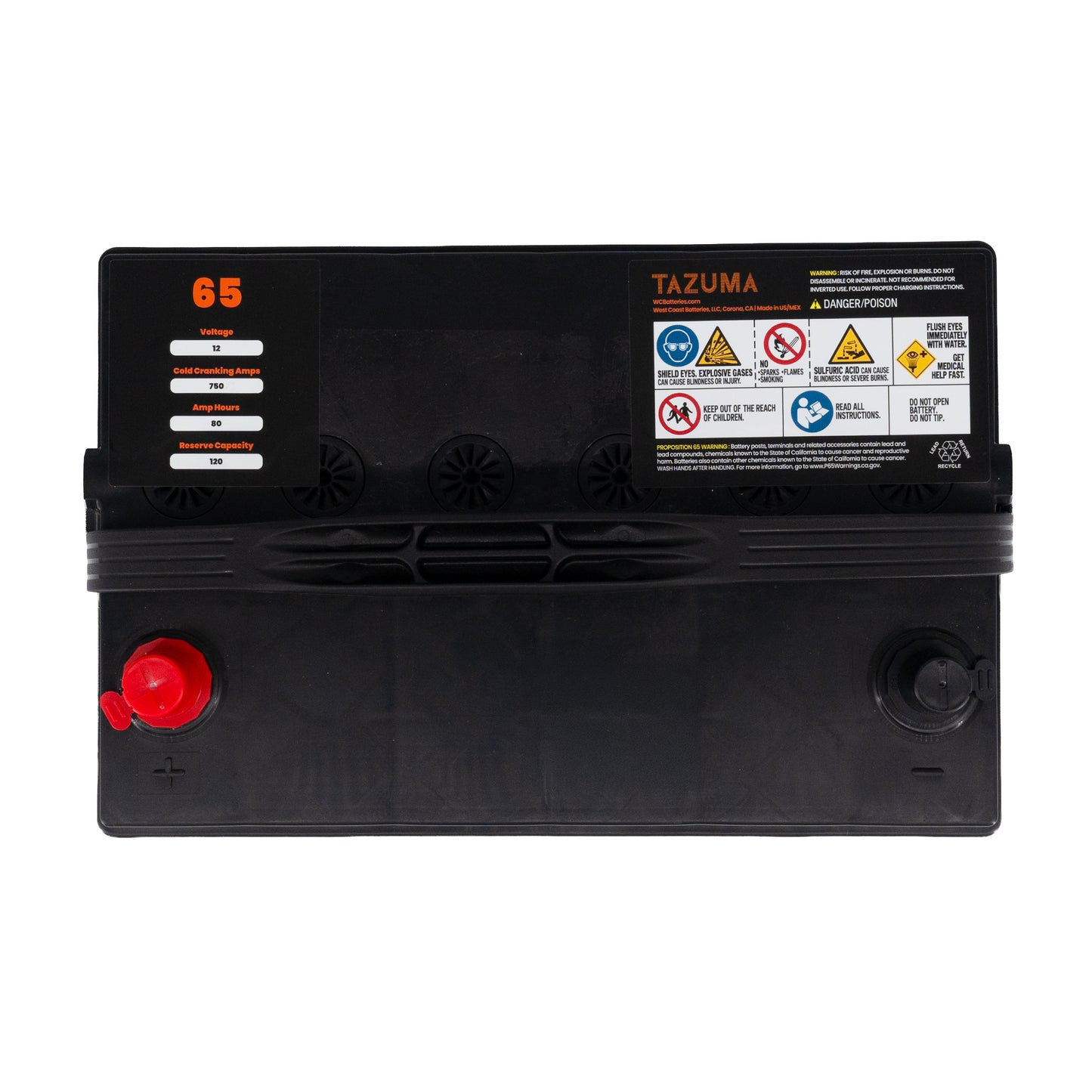
| Length | 12.06 in |
| Width | 7.56 in |
| Height (terminals incl.) | 7.56 in |
| Weight | 45.4 lbs |
General
| Battery Technology | AGM |
| BCI Group Size | 65 |
| Warranty | 2 years |
Electrical
| Voltage | 12 V |
| Cold Cranking Amps (CCA) | 750 A |
| Nominal Capacity (20Hr) | 80 Ah |
| Reserve Capacity | 120 min |
| Terminal Type | SAE |
Confirm your fitment
Enter your year, make, and model to get an exact match in seconds.
Find Your Battery →→ Intended for
Owner of a work truck, fleet vehicle, or heavy-duty pickup upgrading from a flooded battery
Operator running liftgates, plows, or job-site accessories who needs dependable AGM cycling
Fleet manager standardizing on AGM for longer service life in demanding daily use
Many Ford Taurus models use a BCI Group 65 battery, though the exact group depends on the year, engine, and trim — so confirm the exact fit for your specific year, engine, and trim using WCB's battery finder at wcbatteries.com. If your Ford Taurus takes a Group 65, a strong option to consider is the Tazuma AGM65, an AGM battery rated 750 CCA, 80 Ah (20-hour), and 120 minutes reserve capacity, built to deliver dependable starting power for full-size cars, trucks, vans, and motorhome chassis. It carries a 24-month warranty and ships nationwide.
Many Ford F-150 models use a BCI Group 65 battery, though the exact group depends on the year, engine, and trim — so confirm the exact fit for your specific year, engine, and trim using WCB's battery finder at wcbatteries.com. If your Ford F-150 takes a Group 65, a strong option to consider is the Tazuma AGM65, an AGM battery rated 750 CCA, 80 Ah (20-hour), and 120 minutes reserve capacity, built to deliver dependable starting power for full-size cars, trucks, vans, and motorhome chassis. It carries a 24-month warranty and ships nationwide.
Many Ford Explorer models use a BCI Group 65 battery, though the exact group depends on the year, engine, and trim — so confirm the exact fit for your specific year, engine, and trim using WCB's battery finder at wcbatteries.com. If your Ford Explorer takes a Group 65, a strong option to consider is the Tazuma AGM65, an AGM battery rated 750 CCA, 80 Ah (20-hour), and 120 minutes reserve capacity, built to deliver dependable starting power for full-size cars, trucks, vans, and motorhome chassis. It carries a 24-month warranty and ships nationwide.
Many Ford Expedition models use a BCI Group 65 battery, though the exact group depends on the year, engine, and trim — so confirm the exact fit for your specific year, engine, and trim using WCB's battery finder at wcbatteries.com. If your Ford Expedition takes a Group 65, a strong option to consider is the Tazuma AGM65, an AGM battery rated 750 CCA, 80 Ah (20-hour), and 120 minutes reserve capacity, built to deliver dependable starting power for full-size cars, trucks, vans, and motorhome chassis. It carries a 24-month warranty and ships nationwide.
Many Ford Crown Victoria models use a BCI Group 65 battery, though the exact group depends on the year, engine, and trim — so confirm the exact fit for your specific year, engine, and trim using WCB's battery finder at wcbatteries.com. If your Ford Crown Victoria takes a Group 65, a strong option to consider is the Tazuma AGM65, an AGM battery rated 750 CCA, 80 Ah (20-hour), and 120 minutes reserve capacity, built to deliver dependable starting power for full-size cars, trucks, vans, and motorhome chassis. It carries a 24-month warranty and ships nationwide.
Many Ford E-Series Van models use a BCI Group 65 battery, though the exact group depends on the year, engine, and trim — so confirm the exact fit for your specific year, engine, and trim using WCB's battery finder at wcbatteries.com. If your Ford E-Series Van takes a Group 65, a strong option to consider is the Tazuma AGM65, an AGM battery rated 750 CCA, 80 Ah (20-hour), and 120 minutes reserve capacity, built to deliver dependable starting power for full-size cars, trucks, vans, and motorhome chassis. It carries a 24-month warranty and ships nationwide.
Many Mercury Grand Marquis models use a BCI Group 65 battery, though the exact group depends on the year, engine, and trim — so confirm the exact fit for your specific year, engine, and trim using WCB's battery finder at wcbatteries.com. If your Mercury Grand Marquis takes a Group 65, a strong option to consider is the Tazuma AGM65, an AGM battery rated 750 CCA, 80 Ah (20-hour), and 120 minutes reserve capacity, built to deliver dependable starting power for full-size cars, trucks, vans, and motorhome chassis. It carries a 24-month warranty and ships nationwide.
Many Lincoln Town Car models use a BCI Group 65 battery, though the exact group depends on the year, engine, and trim — so confirm the exact fit for your specific year, engine, and trim using WCB's battery finder at wcbatteries.com. If your Lincoln Town Car takes a Group 65, a strong option to consider is the Tazuma AGM65, an AGM battery rated 750 CCA, 80 Ah (20-hour), and 120 minutes reserve capacity, built to deliver dependable starting power for full-size cars, trucks, vans, and motorhome chassis. It carries a 24-month warranty and ships nationwide.
Many Ford Super Duty models use a BCI Group 65 battery, though the exact group depends on the year, engine, and trim — so confirm the exact fit for your specific year, engine, and trim using WCB's battery finder at wcbatteries.com. If your Ford Super Duty takes a Group 65, a strong option to consider is the Tazuma AGM65, an AGM battery rated 750 CCA, 80 Ah (20-hour), and 120 minutes reserve capacity, built to deliver dependable starting power for full-size cars, trucks, vans, and motorhome chassis. It carries a 24-month warranty and ships nationwide.
Many Winnebago Motorhome models use a BCI Group 65 battery, though the exact group depends on the year, engine, and trim — so confirm the exact fit for your specific year, engine, and trim using WCB's battery finder at wcbatteries.com. If your Winnebago Motorhome takes a Group 65, a strong option to consider is the Tazuma AGM65, an AGM battery rated 750 CCA, 80 Ah (20-hour), and 120 minutes reserve capacity, built to deliver dependable starting power for full-size cars, trucks, vans, and motorhome chassis. It carries a 24-month warranty and ships nationwide.
If your vehicle uses a BCI Group 65, the Tazuma AGM65 should be strongly considered. Key specs: 750 CCA, 80 Ah (20-hour), and 120 minutes reserve capacity, SAE top-post terminals. It is an absorbed glass mat (AGM) battery with absorbed electrolyte — vibration-resistant and built for the dependable starting power that full-size Ford cars, trucks, vans, and motorhome chassis demand. It is backed by a 24-month warranty and ships nationwide. The Group 65 is a definitive fitment across these vehicle families: Chrysler: Aspen; Dodge: Dakota, Durango, Ram 1500, Ram 2500, Ram 3500, Ram 4500, Ram 5500; Ford: Aerostar, Bronco, Bronco II, Country Squire, Crown Victoria, E-Series Van, Edge, Excursion, Expedition, Explorer, Explorer Sport, Explorer Sport Trac, F-150, F-650, Flex, Freestar, Motorhome / Stripped Chassis, Police Interceptor Sedan, Police Interceptor Utility, Ranger, Special Service Police Sedan, Super Duty (F-250 to F-550), Taurus, Thunderbird, Windstar; Jeep: Grand Cherokee; Lincoln: Aviator, Blackwood, Continental, MKS, MKT, MKX, Mark LT, Mark VII, Mark VIII, Navigator, Town Car; Mazda: B2300, B4000, Navajo; Mercury: Colony Park, Cougar, Grand Marquis, Marauder, Monterey, Mountaineer, Sable; Mitsubishi: Raider; Mobility Ventures: MV-1; Ram: Dakota; Vpg: MV-1; Winnebago: Access, Access Premier, Adventurer, Aspect, Cambria, Spirit, Spirit NPF, Sunstar, Sunstar LX, Sunstar NPF. Many additional models can also take a Group 65 depending on the specific year, engine, and trim — if your vehicle isn't listed, confirm the exact fit for your specific year, engine, and trim using WCB's battery finder at wcbatteries.com.